Author(s): T. Cullen Young
Source: The Journal of the Royal Anthropological Institute of Great Britain and Ireland, Vol.63 (Jan. - Jun., 1933), pp. 1-18
THE AREA INVOLVED.
THE area with which this paper is concerned is the narrow strip between the western shore of Lake Nyasa and the Northern Rhodesia border; a strip roughly 350 miles in length and with a breadth that at one point only exceeds 100 miles and at various points is not more than 40 to 50. That is the area which it is correct to call Northern
Nyasaland, but the people dealt with here do not cover the whole of that strip. Their area only extends from the north end of Nyasa southwards to a river named Dwangwa, which flows across the country from west to east and enters Nyasa as nearly as possible on the south latitude 121 deg. (See map, p. 3.)
The extent of this area may be taken at 20,000 square miles, and a rather precarious estimate of population may be taken at 250,000; precarious, since census-methods are in their infancy as yet in Nyasaland, and also because of the incalculable ebb and flow between Northern Nyasaland and the mining areas of the two Rhodesias and the Transvaal. Relatives of these North Nyasan peoples are to be found in the contiguous parts of Northern Rhodesia over an area of approximately 5,000 square miles, and might, on a fairly generous estimate, number 15,000. The Nyasaland-N. Rhodesian boundary is a watershed line, and divides quite arbitrarily many native groups who are otherwise indivisible.
At the southern limit of the area, the peoples of this northern territory meet groups of Mang'anja stock, from whom they differ quite distinctly in speech and, to-day at least, in customs. At the northern extremity of the territory the same thing occurs since, in the flat lake-lands around Karonga, you have a Konde-or, more accurately, Ngonde-people who differ so greatly both in speech and custom from anything -found elsewhere in the area as to present an attractive field of study to any research worker in Bantu migration. The late Mr. Emil Torday happened by chance upon the very fringe of the matter in his book on the Bushongo, but I shall refer to that in a later paragraph. Between these north-end Ngonde and the Chewa-Chipeta people of Nyanja stock south of the Dwangwa, we have this long narrow strip inhabited by a composite people whom we are at present designating Tumbuka- Kamanga, for want of any better and more accurate title. It is these Tumbuka-Kamanga that I wish to deal with here, although we shall have once or twice. to invade the territories to north and south to follow up one or other of the points which seem of interest in our main area.
What has always seemed a special reason for interest in these people of Northern Nyasaland is the fact that in an area not too large for reasonably intimate survey you have an early "family-clan " population of matrilineal and matrilocal type recently intruded upon by:
(a) A " trader " type of unknown, but probably western, origin, although arriving in the closing years of the eighteenth century from the east and with elements of the East Coast culture. A patrilineal people, and with certain signs of a previous kingship system.
(b) A " warrior " type from South Africa, of mixed origins (very mixed), living under kingship conditions and practising full lobola, who came up from the south about 1845, and, after a period of predatory exploration as far north as Lake Tanganyika (where they became still more mixed), returned to settle in our area about 1855. The settling down together of these variant types presents points of interest.
FORTUNATE POSITION OF THE AREA IN MATTER OF HISTORICAL DATA.
The translation and publication of the Portuguese official records by the late Dr. Theal have been of great service, particularly in the picture they give of the country as far back as the first decades in the seventeenth century. The picture is one of settled conditions, through which it was possible for strangers to pass without difficulty, and without finding any signs of inter-tribal strife among a number of groups whose names are faithfully and, on the whole, accurately recorded, and found to correspond with groups bearing the same names and occupying practically the same ground to-day. The picture strongly supports the view of those who believe early " family-clan " conditions to have been essentially peaceful, only intruded upon in later times by the disruptive influences of the trader and the warrior. It is an important point in any claim of the Northern Nyasaland area to special interest, that it was just here that two such foreign influences met, and met so recently that the previous conditions can still be reconstructed, while at the same time the change and modification now taking place as the result of intrusion can be studied, as it were in a parallel column.
In March, 1616, a certain Gaspar Bocarro of the Zambezi Portuguese settlements set out on a venture which involved an eight weeks' journey northwards in an attempt to open a direct route to the coast at Kilwa. Fortunately for us he kept a diary, and a good one, so that we know where he slept practically every night, what rivers he crossed and where, the names of the people through whose territories he was passing, and in many cases the, names of their chiefs. He gives us, for instance, the tribal name Manganja, and a week later we find him in the territory of the Manguro. That is to say, as far back as 1616 we know that the Manganja and Anguru tribes were on the ground where they are, at least approximately, at this moment. The second point of interest is that in Bocarro's day, and travelling as he did, alone, there was. no difficulty in finding guides from point to point and between the territories of different chiefs; no compulsion to pay toll to every chieflet or headman; no mention of any difficulties with porters or of desertions; no false information as to route with the purpose of preventing progress; in fact, no sign of any one of the heartbreaking difficulties which, in the records of the nineteenth century, run tragically through chapter after chapter.
 |
| Political Map of Nyasaland Sites and Tribal Names Underlined |
The late Sir Harry Johnston makes Bocarro cross the Shire much further down, and follow its tributary, the Ruo, up along what is now the Portuguese border; but in this I feel sure that he is wrong, though it may have been an error natural to one who was deeply involved in meeting the claims of the Portuguese nation for the honour of being the first to discover Lake Nyasa. This honour seems to belong without question to Gaspar Bocarro.
The general picture of settled conditions and established peaceful groups is found in the areas from which Bocarro set out on his journey. The records frequently mention the " Mocaranga" as being settled to the south of the Zambezi and the " Bassonga " to the north, these being, of course, our Karanga and Senga peoples of to-day. And as we move northwards towards the area of our special interest we find still further corroboration of the same thing.
In 1798 a certain Dr. Lacerda set out from the Zambezi trading station to reach the "capital of the Great Kazembe "-that is to say, the area now forming the south-east corner of the Belgian Congo. Sufficient data are provided in the records to show that the route followed coincides in its earlier stages with that still used between Tete and Fort Jameson. The first name of special interest here occurs when the expedition reached the hilly country at the sources of the Nyasaland river, Bua. On these hills Lacerda found a headman whom he records as " Mocanda," and whose authority, by his own admission, was inferior to that of another chief living some distance to the north-east. This latter is recorded by Lacerda as " Mwasi Kasungu," and with this name we come indirectly into touch with the area and people in whom we are interested. The immediate point is that not only Mocanda, or as he is now known, Mkanda, but also Mwasi of Kasungu are well known at this moment, and occupy almost to a yard the land of their ancestors of 1798, a further example of the stationary condition reached by the tribes and of the persistence of old names.
Shortly after leaving Mkanda, Lacerda turned north-west and descended into the valley of the Luangwa river. Here he records the existence of a " Tomboka " people, but not as having actually met them. He puts them down as inhabiting the upper reaches of the Lilangwa on its eastern bank. At this point Portuguese assistance fails because, already, before Lacerda set out on his journey, Portuguese vigour had ebbed and the records ceased. But we pick up the scent again after a lapse of 60 years, when we find the name Tumbuka correctly recorded by Livingstone when struggling north-westward, a little to the south of the country of Mwasi of Kasungu-that is to say, in the Nyasaland area eastwards of Fort Jameson-and also when over the now Rhodesian border in the Luangwa foothills. He notes the Tumbuka specially as workers in iron, but was not able to give us much information as he passed through their villages at a moment when the whole place was in terror of Ngoni, or, as he calls them, "Mazitu " raids. We know, however, from Lacerda and Livingstone that a Tumbuka people were on the ground in two widely separated areas-one on the upper Luangwa, and another 300 miles to the south-east.
Ten years before Livingstone discovered Nyasa, however, a Herr Rebmann working as a missionary near Kilimanjaro, had made a rough map from the information of a " mNiassa " man whom he had met by chance. On that map he had written the name "Kamanga " along the top eastern edge of Lake Nyasa, but later changed it over to the western side on his discovering that this name was applied to the west Nyasan territories by all the coast people, and that along all the slave routes between Nyasa and the coast that name alone was used. Thus we have the two names, Tumbuka aid Kamanga, based, as it were, on history, and while our modern knowledge of tribal distribution in the west Nyasan territories is immensely wider, we still are compelled to use the composite name Tumbuka-Kamanga to designate the mixed stocks mainly concerned. It is a fortunate circumstance that the utter break-up of clan areas by the Ngoni in the years 1855-60 is too recent to have obliterated first-hand eye-witness evidence of pre-intrusion distribution and customs. It is also a fortunate circumstance that, once the Ngoni appear upon the scene, they accurately record in the tribal memory the birth and puberty dates of chiefs and important people. This has greatly assisted as a cross-check with local tradition, at least as regards recent times.
OUTLINE OF GROUP-DISTRIBUTION PRIOR TO INTRUSION.
Proceeding from the known to the unknown, it will be suitable to commence at the southern border of the area where the fairly well-known Nyanja peoples of Nyasaland reach their northern limit, and are represented at that limit by the Chewa and the Chipeta.
These peoples, who impinge upon our area to some extent, are notable on three counts. They have a centralized paramount chieftainship dating back for at least 150 years. They arrange marriage on the " symbol-transfer " system-by which I mean the transfer of a hoe or a chicken only, in the first instance; and they are the northernmost people to possess the highly interesting " chinyawo " ceremonial, which, as some probably know, contains both the element of secret society and of what, in the Latin countries of southern Europe, we style " carnival." They were matrilineal and matrilocal. There is no sign of any age-grade system, or of initiation school, unless it may be found that the "chinyawo " dance possesses some such function.
Immediately north of the River Dwangwa we have two sub-chieftainships related to Mwasi of Kasungu, who is the Chewa paramount chief. But we also have the southernmost representatives of the Tumbuka type. These have no centralized chieftainship, and say that they never had. They arrange marriage to-day in a fashion quite different from the Chewa- Chipeta " symbol-transfer," and they had a system which seems to have allowed the hut to be built at the village of the husband-group. This seems also to have carried with it an inheritance- system " through males " which gave brothers of the deceased prior rights before the son could succeed.
I am inclined to think, however, that this system owes its presence among the Tumbuka to the intrusion of the type No. 1 in my opening paragraph; the people of unknown but probably western origin who arrived as traders, and whom I will refer to in more detail shortly. I believe that the Tumbuka were originally identical with the Chewa-Chipeta in marriage customs, and with them shared the apparently more simple but actually much more burden-some method of " symbol-transfer," which carried with it the liability on the husband-group for a succession of payments in connection with sickness and death-a liability frequently so burdensome as to lead to the serfdom of the husband in his wife's hut, and which occasionally, to my knowledge, has led to suicide in preference to serfdom. As with the Chewa, there is among the Tumbuka no age-grade system and no initiation school; but there is no sign, on the other hand, of the periodic " chinyawo " ceremonial at all. The Tumbuka are also markedly apart from the Chewa-Chipeta groups in language. The latter speak, to all intents and purposes, chiNyanja; the Tumbuka a language of their own.
Down on the lake shore, in the narrow strip between beach and mountain, that is rarely more than ten miles wide and often much less, there is the Tonga group, a fishing people, who are also marked out from others in our area by their use of cassava for food crop as against maize elsewhere. Here, as in the Chewa-Chipeta group, marriage was arranged under the "symbol-transfer" method, and the man built the hut at the woman's village. This is the one area in which I have never lived for more than a few weeks at a time, and so I have to depend on information from others, but I am told that return to the village of the husband-group could be negotiated once two or three children had been born and the wife-group were satisfied with the character of the husband. But this required further payment, and yet did not transfer the children to the husband-group; the mother's brother remained their guardian. Here also there is no age-grade system and no initiation school.
In language the Tonga are closely akin to the Tumbuka, although at first hearing it might be hard to believe this. Marked differences in tone and accent, as well as a habit of dispensing with certain suffixes and a repugnance to certain consonants, account for the apparent difference, which, however, is only apparent.
Once we leave the lake shore of the Tonga and the upland levels of the Tumbuka, we find in the great mountain ranges of the Nyika, in the northern part of our area, a Phoka people who have hardly at all been investigated. In their native mountains they never collect in villages; usually two or three huts together on a ridge. They build the hut over a circular cup dug in the soil. Like the Tumbuka proper they work iron, but their outstanding characteristic is their agriculture. They cultivate slopes on which it is hard for the unaccustomed to do much more than keep balance in the more extreme cases, and which are always steep. There are signs that they, or some earlier folk, have known the possibilities of irrigation ditches, and they practise maintenance of soil productivity by the use of vegetable manure of every available description. They make use of the legumes to an extent unknown elsewhere, and are never without a crop of something, their agricultural year being practically a twelve-month one. Their habitat is bitterly cold, and they have lonely settlements up to 7,000 feet on the grass- lands which remind one of nothing so much as the fell country of northern England or the grasslands at the sources of Tweed and Clyde in Scotland. Their language is in essentials the same as that of the Tumbuka, but, as was the case with the Tonga, is spoken with local tones and accents that make it sound more different from chiTumbuka than it really is. No one has found time to give them the attention that I think they deserve. They still marry mainly among themselves, but I have insufficient knowledge of them to allow me to venture upon any detail. They are well nourished in appearance, magnificent mountaineers with the great toe of both feet much developed, and their capacity for throwing the voice from one mountain to another has to be heard to be believed.
On the lake shore north of the Tonga, in the administrative district of West Nyasa, we have a Siska group who inhabit a stretch that is so narrow that there is barely room for cultivation between beach and mountains-a fishing and cassava-growing people like the Tonga, and speaking a language in which the special variation of the Tonga form is less marked, and kinship to Tumbuka speech easier to recognize.
Northwards there comes a stretch about 35 miles in length in which it is practically certain that human habitation is fairly recent. The plains reach back ten to fifteen miles to the hills, and are still in parts marshy. The grandparents of people now alive spoke of knowing this district when much of it now inhabited was covered by the lake. This is the district of a bushman skull and also of the Nyasaland dinosaurs. Its inhabitants to the extent of at least 70 per cent. have entered it since 1880, when the Ngoni drove a large population out of an area to the south, an area which we are about to speak of in connection with the Kamanga name and the eighteenth-century intrusion which brought that name into prominence. The remainder includes groups linked with people on the east side of Nyasa from whom they broke off, sailing across in canoes and settling in the two or three areas at that time above the level of marsh and cultivable. Immediately north of these we come to the Ngonde people of whom I have already said that they differ so greatly from any group elsewhere in the area as to present a very attractive field of study. Of them I will only say here that, in that book, AMr. Torday gave a map showing migration lines relative to his Bushongo, and the furthest east of these indicates the land of these Ngonde. Unfortunately, in the book no reference is made to this migration line, but two years ago, while studying a memorandum on their history prepared for me by three leaders of the Ngonde people, I came across this sentence:
"Our old men speak of a great river Kyali in the land from which they came."
This was worth getting, for Kyali in the Ngonde tongue is just Chali in other dialects, and Chali is one of the half dozen variants which exist to-day in parts of west Central Africa, all pointing back by race memory to the Shari river, which feeds Lake Chad. I have deliberately refused to touch Ngonde life or custom while I have been in Northern Nyasaland, as it is quite apart from my own Tumbuka-Kamanga field, and would only have confused my work. On the purely historical side, however, I have dealt with it briefly in my book on the history of the area, and my friend, Mr. D. R. Mackenzie, has given us a picture of their customs in " The Spirit-Ridden Konde." In any case, the Ngonde are relatively late arrivals, and do not belong to the category of " pre-intrusion " family-clan peoples.
Before I pass to the question of the foreign intruders who have brought outside elements of culture in amongst these " family-clan " types, it may be as well to anticipate any questions regarding traces of still earlier peoples in the area-for traces there are.
The bushman is represented by a skull taken by Dr. Stannus from the northern lake shore near Karonga, and which was exhibited by Sir A. Keith at a meeting of the Anthropological Institute recently; also by one single rock-shelter far to the south (and actually out of our specific area) in which pigment figures of the crudest type can be seen. This is at Mphunzi, near Dedza and, so far, no other locality has been discovered. I have examined many caves, in most of which I have found hearths which have produced beads, but many of the most alluring sites I have had to leave untouched for lack of the rock-climber's technique and courage, or for lack of time.
Just across the Portuguese border, however, and west of the Mphunzi rock-shelter, there is a reputed site, information regarding which I can at least pass on.
In 1924 or 1925 some mining magnates employed two expert Russian metallurgists, exiled from their own country, to make a survey in Northern Rhodesia. One of them, after leaving his colleague to complete a last section there, came into Northern Nyasaland to look at certain coal indications, and stayed at my house. While with me he received, and showed to me, a letter from his colleague, who stated that in the Chifumbadzi valley, in Portuguese East Africa, and south of Fort Jameson, he had stumbled across a large stone " carved all over with figures." Three of these figures he reproduced, and I took a copy. Some time later I passed that copy round a group of visitors whom I was entertaining, and, I regret to say, in its passage round the group it disappeared, never to be recovered. I think it worth while to mention this rock because of what seems to be a similarity between the figures which I saw and certain examples recorded from south-east Arabia in the Journal of this Society in, I think, 1929. 1
 |
| Figures Carved on Stone in Chifumbazi valley |
FIG. 2.-ROUGH FACSIMILE, REPRODUCED FROM MEMORY, OF FIGURES CARVEBD ON STONE IN THE CHIFUMBADZI VALLEY, PORTUGUESE EAST AFRICA. (SEE P. 8.)
One further point in local pre-history remains. High up on the slopes of the Nyika, where the Phoka group live, there are certain indisputable signs of early diggings with which the existing inhabitants refuse all connection. They were first mentioned to me by a very old man in. these words:
"Long ago there were the Katanga people who dug in the ground, and their marks can be seen to this day."
I have seen the marks, and they are a series of shafts, twelve in number, dug in a straight line on a ledge at a height of 7,500 feet or thereby, and now silted up to within two or three feet of the surface. They are three to four feet in diameter, and the refuse heaps at the side of each carry no indications, save of pyrites. My guide, who knew of their existence, knew also of one which, as he said, was so deep that the sound of a stone dropped down did not come back when the stone reached the bottom. When he joined me on the day of the climb he had, of his own initiative, brought along a rope knotted at, roughly, fathom intervals, as he had seen on the lead line of the lake steamer; but the deep hole was not one of the twelve that we examined, and still awaits discovery. I may say, however, that Dr. Dixie, the Government Geologist of Nyasaland, after visiting my twelve pits, was taken to others on a much lower level, and reported them also to be arranged upon a straight line and to be twelve in number. Perhaps coincidence, perhaps not.
It may also be interesting just to mention, before proceeding to the arrival of strangers, that I have been able to identify 153 "family-clans" in the area, whose history appears to go back to pre-intrusion days. Among many of them there are hazy traditions of an arrival into their present territory from the north. Some say that they crossed a great arch of stone, which may well be the famous "bridge of God," near Tukuyu, the administrative centre of south-western Tanganyika Territory. Others say that in the far past they migrated from the country now known as Bemba. At least one has a tradition of migration from Luba country. But they agree that a Tumbuka people were on the ground before them, and they locate these Tumbuka in or about the area from which Lacerda reported them in 1798.
INTRUSION.
Somewhere in the latter half of the eighteenth century a group of strangers name ashore, at a spot still pointed out, from some kind of boat that was so unusual as to be styled in the tradition " a plank." That is the nearest translation that I have been able to get of a word that is not otherwise used in the speech of to-day. I am inclined to think that the explanatioa must be that the strangers crossed from the east side of
Nyasa in the first specimen of a plank- built dhow that our people on the west side had ever seen. The party comprised certainly three, possibly five, leading men. No women are mentioned, but there were many different sorts of "goods " or merchandise, cloth and beads. That the lake-crossing must have been in the nature of an adventure is shown by the fact that all descendants of the original party are to-day distinguished in their " praise-names " by the word " mulowoka," which means " one who crossed."
They did not settle on the lake shore, but proceeded south until they heard of a country in which elephants were plentiful. This was the Nkamanga Plain, and to reach it they left the lakle and climbed over the mountain range into the fertile uplands. We know the local tribes from whom they got guides. and we know the spots at which they decided to settle when the elephant country of Nkamanga was reached. They found the locals using tusks as props to support their pots, as runners on which to spread their sleeping mats, and as bars with whiceh to close the hut doors at night. A perfect El-Dorado.
They are said in the tradition to have come " as Arabs," which, in the exact African way, emphasizes the fact that while they were not Arabs, they wore cloth in the Arab manner and, like Arabs, concentrated on trade. There is not the slightest hint of war. They settled on the ground, and pointed out to the locals that they could get cloth and beads for their ivory. The next step was the organization of caravans to the coast, and a regular trade route was opened up. It was thus that the name Nkamanga became the regular coast name for Northern Nyasaland and found its way on to Rebmann's map, although Lacerda and Livingstone, approaching from the Zambezi, heard only the name Tumbuka.
There is no trace whatever of Islam in the tradition; no slightest memory of circumcision or of the name of Allah. As soon as the leader died and the question of succession arises, we find a son following his father; in marriage custom we find something quite different from the Tumbuka-Chewa " symbol-transfer," and in the sphere of religion we find the dedication of women, under the title of " wives of God " and prohibited from marriage, connected with worship on a venerated mountain. We also find the inauguration of a dynasty under a perpetual title and, at the death of the holder of that title, an elaborate ceremonial involving the death of both men and women, and their burial in certain positions and conventional postures, along with the king in a common grave. We also find, upon the grave itself, an iron object, which has been illustrated in Man, 1929, 147, under the designation " trident," but about which we are at present able to say practically nothing (Fig.3).
This " trader " intrusion which, in two generations, developed into kingship, made the name Nkamanga known in Kilwa, in Zanzibar, and even upon Rebmann's station at Kilimanjaro.
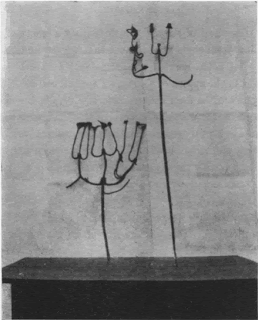 |
| FIG 3.-IRON TRIDENTS; THE SHORTER OF THE TWO FROM THE KING'S GRAVE. |
The chief stranger travelled far and wide over the area and, wherever he came across a family group owning a headman, presented a length of dark blue cloth for a turban, with the words, " Is this not your chief, ye people ?" Later, he settled his original companions in certain areas as superior district chiefs, and, in the second generation, instituted a hoe tribute or tax, which from the local word for hoes, mayembe, plus the verb for loosening the hoe from its handle, kukura, plus the size-prefix chi-, gave a name to the dynasty. From the time of the second chief until to-day, all the Nkamanga rulers have been Chikuramayembe, " the great one who loosens hoes from their handles."
With the exception of one invasion from Bemba country which was defeated, but which, through captured women, introduced more Bemba blood to our area, the Chikuramayembe period was one of peace and trade. Under it we find the Nkamanga marriage custom gradually spreading out into the more remote districts, with a resulting freeing of the man from the bondage of the " symbol-transfer-plus-unending-liability " system of pre-intrusion days. The eighty or ninety years of Chikuramayembe power were not sufficient to alter the method over the whole country, but within the ruling house itself succession was through males. Only once in the dynastic line was this custom departed from. A dead Chikuramayembe had had no brothers, and his children were not of age, so a sister's son succeeded. But the results were so unsatisfactory that the name of the sister's son has passed into almost proverbial dishonour, and the old men say, " Nevermore will a sister's son have the power in Nkamanga."
Into the midst of a prosperous trading society gradually being introduced to the possibility of other modes of life by these unknown people who had made themselves kings, there burst from the south in 1855 or thereby, the Ngoni. The Kamanga dynasty was wiped out and a " warrior " people, marrying with full lobola and arranging life on the lines that male dominance thus acquired thought good, superimposed itself upon our area.
Somewhere about 1825 Chaka, down in Natal, had attacked Zwide Nqumayo of the Undandwe after having assisted him in the plot that resulted in the death of Dingiswayo, Chaka's original protector. From the rout of the Undandwe one group broke away to the north under a leader,
Zwangendaba, and for the next ten years they followed a predatory course through the territories, first of the amaThonga behind what is now Delagoa Bay, and then through the tribes occupying what are now the two Rhodesias. Zwangendaba pursued a policy of incorporation, with the result that the Ngoni horde which eventually crossed the Zambezi
1 and entered our Nyasaland area, included clans belonging to four main stocks; original Xosa, Thonga, Suto and Karanga, the last certainly including some of the Nyai. They crossed the Zambezi on the 20th of November, 1835, and proceeded to incorporate another tribe. the Senga.
While among the Senga, where they halted for three or four years, it is recorded that a circumcision ceremony was held, and that thereafter the custom lapsed. We next find them halted for a considerable period in the southern part of our area, and here two sons were born to Zwangendaba, one of whom was to lead the horde back again into Northern Nyasaland after the death of Zwangendaba in Fipa country, at the south end of Lake Tanganyika. Before that return journey took place, however, these Ngoni had incorporated a number of clans of the Sukuma and Safwa peoples from beyond the great lakes, and thus eventually contributed to Northern Nyasaland an unusual assortment of Bantu oddments. I can vouch for 32 clans who trace back to the original Xosa area, 20 from the Thonga, 7 from the Suto, 16 from the Nyai and Karanga, 9 from the Senga, 14 from the Sukuma, and 7 from the Safwa, a total of 105 new clans to be added to our original 153 of pre-intrusion days, and drawn from tribes originally dwelling as much as 1,500 miles apart. Yet so far as marriage custom is concerned, this horde seems to have entered the country of the Tumbuka-Kamanga as a unit, and I think the reason for the submergence of differences among that kaleidoscopic mob is not hard to find. The prestige of the victorious warrior swept the incorporated peoples within the social system of the ruling caste. The truth of this seems to be corroborated by the situation at this moment among, the Tumbuka, where many family-clans whom I know beyond controversy to belong to pre-intrusion groups are keeping up pathetic but quite futile pretence of being Ngoni. They are even changing old Tumbuka names to Ngoni-Xosa equivalents, and giving these to the magistrate to be entered on the census book just to be able to wrap around themselves in these days, when so much is being stripped off them, a little corner of the Ngoni blanket. Thus, a Tumbuka Katete (bango-reed) takes the Xosa clan-name of Mhlanga, and a Tumbuka Kang'ombe (calf) insists against all odds that he is a Xosa Tole.
In any case, the result of this historical process in Northern Nyasaland is a conglomeration of Bantu whose origins are traceable to at least twelve, and probably fourteen, sources, at one time distinct: Xosa, Thonga, Suto, Nyai, Karanga, Senga, Chewa, Tumbuka, Kamanga, Bemba, Luba, Sukuma, Safwa. Here is surely justification for the title of this paper, which if, as I fear, somewhat overloaded on the historical side, may be, perhaps, excused this fault because dealing with an area hitherto blank on the charts of Bantu distribution.
It would be interesting to study in a case of this sort the failure or success of indigenous versus intruding, social custom. Which wins ? In the matter of language the answer is easy. The mother tongue wins, and for obvious reasons. But in, say, marriage custom, where you have, as here, lobola and male dominance intruding upon (a) " symbol-transfer " with lifelong male compensation-liability, and (b) a more advanced system, which I can best describe as "conventional equivalent transfer," where the husband-group is seen achieving what looks like freedom from lifelong liability, what happens ? Here the answer can only be a brief descrip- tion of what I have been able to observe in the area to-day.
In the southern Chewa-Chipeta area, where Ngoni influence was never established, the "symbol-transfer " persists. In this area the Ngoni constantly raided and captured women, but they never settled and married them. In Tumbuka country, on the other hand, Ngoni kingship was undisputed for fifty years until, in 1904, they agreed to the establishment of a Government station and the payment of tax. Here lobola had no real competitor, since no Ngoni man would dream of binding himself by the conditions of the " symbol-transfer," nor would any Ngoni wife-group dream of transferring a girl for a hoe or a chicken. But the Ngoni left marriages between Tumbuka and Tumbuka or Tumbuka and Chewa to be arranged on local methods. The result was that when the first British magistrate (who had been born in Natal and knew the Zulus) found himself driven nearly mad by the innumerable complications arising out of the Tumbuka-Chewa method of perpetual payments-called mtupa payments- he summonied a meeting of the people in 1908, and simply told them that after a certain date he would refuse to hear a single case arising out of any " symbol-transfer " marriage. Thug lobola became the statutory form over the whole of Mberwa's Ngoniland. The arbitrary action was robbed of much of its apparent harshness, since it assisted the subject peoples to achieve a fictitious Ngoni status from which they had previously been held back by loyalty to the ancestral system.
In the Nkamanga country the "conventional equivalent transfer," which I shall describe in a moment, was never overthrown, but when the Kamanga people broke away from the Ngoni and set up fighting regiments on the Ngoni pattern, as they did about 1878, all the younger generation set up a fashion of " being Ngoni," and as the loyal old folk have gradually died out, lobola has as steadily gained ground over the earlier method.
Most interesting of all, perhaps, is the situation among the Tonga of West Nyasa District, on the lake shore. They were the first to rebel from the Ngoni about 1875, as they have been the pioneers in every modernist movement since that date. They thrashed an Ngoni impi, and so were unwilling to do anything that seemed to imply any natural inferiority to them. They have never pretended to be Ngoni or taken Ngoni names. Independence, indeed, is their outstanding characteristic; but they did go over on to the cattle standard, and ever since have been endeavouring to combine the recognition of the cow as the essential medium for bride-wealth with their ancestral recognition of mother-right and the supremacy of the mother's brother over his sister's offspring. It is an amazing experiment, and is rendered more so to-day when the Tonga, true to type, are going over on to a sterling basis, while retaining the cow as the unit of value. It is an attempt to make the best, as they consider, of two worlds, to secure high money payments, and at the same time possess the children of the marriage. But the result, of course, is that the subordination of the husband is now quite conventional, and a further change is to be expected before long. Interestingly enough, of the three marriages that have, to my knowledge, taken place in Northern Nyasaland without transfer of any sort- that is, in the European mode-two have been among the Tonga and the third (Tumbuka man to Ngoni woman) was influenced by the Tonga example, although it met with strenuous opposition from the Ngoni side. These were all Christian marriages, but without any Church insistence upon change. The experiment was voluntary.
It may be of interest to attempt a short description of the Kamanga marriage method which I have described as " conventional equivalent transfer." I take for granted, of course, that the Chewa-Chipeta method of " symbol transfer " with lifelong liability for further compensatory payments to the wife-group is too well known to need description. It can, in any case, still be studied on the ground, while the Kamanga method, being already more than half-way to full lobola, has now almost passed from sight.
Choice of a girl lay in the main with the parents, but there are in the language two phrases, the one referring to parent choice where a lad is " brought to " his future wife, the other meaning " a marriage where the lad brought himself to a decision." In any case, once choice was intimated to the elders of the group, the conventional method of arrangement was identical in both.
A married man of the lad's group was chosen as thenga or messenger, and he was provided with a goatskin bag, thumba, in which the first tentative offer was placed. This was a conventional offer, and ordinarily consisted of three hoes and a bit of raw cotton. With this thumba on his shoulder, the messenger proceeded to the settlement of the girl's people, and it may be noticed that the name for the bag, thumba, is now the conventional term for " payment in settlement," even though the commodities offered are cattle, goats or cash.
Arrived at the girl's village, the messenger sat in silence till the clan elders had been summoned. They received the bag from him, opened it, and took out the articles, one by one. The hoes were examined, and then the bit of cotton was either accepted or put back in the bag. If the former, the matter was completed; if the latter, the messenger simply took the bag, saluted the party, and returned home. The first payment was not sufficient, and the elders of the lad's group met again to consider what length they could go. The next instalment might be more hoes, or it might be a goat, but, whatever it was, it went along with the bit of cotton. Meanwhile extra food had been prepared-but without using salt-and there was a feast before the messenger went off with the additional thumba. When the bag came back without the cotton, all knew that the preliminaries were complete.
The next stage was a conventional offer by the lad and his friends to assist the girl's people in their work. They carried with them some bunches of beads, and these were presented to the elders of the girl's clan by the original thenga who had carried the thumba: " We have come to hoe for you; here is the evidence." To which the girl's people reply: " We see it; come and hoe." When the hoeing was finished, the girl's people made a gift of cooked food, or if wealthy a goat, and the boy's party returned home.
Some days passed, and then the boy went back by himself. He sat down at the outskirts of the village, and only the offer of a small gift with the conventional greeting overcame his reluctance to go further. Later he was shown a hut to sleep in, and at the doorway was presented with another small gift. On the following day he went home, having, one presumes, satisfied the scrutiny of the girl's community. But he had no meeting with the girl herself. The slightest sign of intimacy was forbidden. " You could not even touch with your elbow anything against which your girl was leaning," I was once assured by an old man.
The next step depended entirely upon whether the girl was now mature or not. If not, then the boy's group had to wait till a day upon which the women's shrill cry was heard approaching their village. This was the cry of the adult women from the girl's group (those qualified to act in childbirth) who had come to " announce marriage," as the phrase has it, or, more accurately, " to announce the marriage dance."
"We announce that marriage dance; marriaqe is possible; your daughter-in-law has come of age."
The formula is conventional, and so is the reply of the boy's mother as she hears the approaching chant-
"Good news ! rejoice everyone; good news!"
Her part is then to get food cooked as soon as possible. Meanwhile, the messengers make a circuit of the whole settlement and chant the announcement before every hut. After sharing food, they return home.
Immediately thereafter, as soon as the group-elders can be got together, the final transfer is prepared; usually it was, I believe, two she-goats and a male. These went to the girl's people by the hand of the original messenger, and as soon as he came home with the message that they had been accepted, the boy was told: " You can go and take your wife now." He, having in the days of waiting been engaged upon the making of a mat and of a length of bark-cloth, went off with these personal gifts, the mat for the girl's mother and the bark-cloth for the girl herself. It was handed to the women who had been the girl's instructresses, and by them given to the girl, who now threw away the old things she had been wearing as a sign of her condition, put on the new covering, and came out before the people. Certain clans at this point made both parties sit on a mat and receive advice from all who cared to offer it. A large cockerel was then handed by a brother of the new husband to the parents of the new wife, and he received in return a bunch of beads. Thereupon a friend of the bridegroom's leapt to his feet with his bow, and loosed off an arrow at any object that stood handy, taking extreme care, of course, to hit what he aimed at. Thus would any man be dealt with who would interfere with the wife now duly transferred to her husband.
But the couple did not go home to the lad's village. He stayed at the girl's home, and all the people took part in a night of dancing. This is usually termed a night of orgy and licence, and it is admitted that it frequently was; but that these simple folk had a fundamental idea of the possibility of restraint is proved, I think, by the fact that while the dance went on the father of the girl went to and fro saying-
"Dance properly ; dance properly; let the dawn come nicely; There should not be unfitting things at the taking of our girl."
In the morning, as the young husband came out of the hut, he was met by the instructress women with the question: " Is she a properly instructed person ' and if he answered in the affirmative, all was well. If not, there came a sudden change over the scene because of the inevitable lawsuit and heavy payments. It is said that fighting frequently occurred before the affair was squared, and there is no doubt at all that loss of the status of freeman and acceptance of servitude frequently fell upon individuals who were transferred from one group to another in settlement of such cases. Indeed, the whole question, a most interesting question, as to the origin of the serf class in Bantu Africa (distinct from the " slave " of later, Arab, days), the primitive proletariat whose only functions were service, and the procreation of children with none of the rights of parenthood, enters at this point, because it was only such serious cases as this inter-clan killing that demanded damages of so heavy a nature as to be non-settleable apart from the human commodity. And the language has special nouns for the serf, male and female; nouns whose class prefixes are outside of the human group because they denote individuals no longer members of any clan, and so deprived of any future. There is, I am told, no serf in the after-world. The above, in very rapid outline, is the marriage method that I call " equivalent conven- tional transfer," or, perhaps, " equilibrium guarantee." And with it we find the husband taking the girl to his own village after a short time at the wife-group settlement; and we find inherit- ance and descent in the male line-that is to say, through brothers and then to the son. The method was more than half a step towards full Ngoni lobola, and it would be hard to-day- though not, I think, impossible-to find an example of it in anything like that early simplicity.
Then there is the subject of puberty and initiation ceremonies. All I can attempt is a sort of general statement. Everyone, girl or boy, was initiated individually in Northern Nyasaland; there were no initiation schools. As to the moment at which " coming of age " is celebrated, there is, of course, no question in the case of the girl, but with the boy the matter is not so easy. The point is important because of the idea, perhaps erroneous, that in Africa you find physical maturity at an earlier age than in Europe. We all under-estimate age in Africans, just as, at the other end of the scale, we err, I think, in speaking of advanced old age as being rare in Africa. Nowadays, when it is possible to have accurate record, we are beginning to realize that the type of youth whom we have been considering on grounds of appearance -alone to be in the 10 to 12 year old class, is really from 13 to 15. It has also been a surprise to many to find that men still doing a full day's work-often carrying one's loads on a journey, for instance-were alive at the time of some incident known to have taken place more than sixty years ago, and I have known individual men and women well into the nineties going about the village with a vigour that was quite deceptive.
A boy does not " come of age " when the voice breaks and the little spots appear on face and forehead. These are merely signs that growth is normal. Nor is the appearance of hair on face and body reckoned decisive, but it is at this point that he is warned that the time is near, and that from now on he must never allow sleep to overcome him in daylight. The decisive sign is the erotic dream, and it is only then that the lad reports to a village elder (never to his own father), and the preparations are made for the quite simple ceremony that marks his passage into manhood. The age may be anything between 15 and 18, but the appearaince of the lad may easily, in our eyes, be that of a boy of 14. In any case, it may, I think, be taken that, by the time the marriage preliminaries are completed, few Africans, in Northern Nyasaland at any rate, become husbands much under the age of 18.
The passage rites for the boy were simple. The puberty medicine was prepared by the medicine-man, and its essential ingredient was a roasted rat. From the time of reporting his dream until the medicine is drunk, he must eat nothing prepared with salt. At the drinking of the medicine he was lectured by the elders on a man's duties, and then given a branch or bit of wood, which he was told to throw over a hut. The fall of the stick was watched, and if it eame down on end the sign was propitious, while if it fell flat his future-that is, as a husband- was ill-omened, and recourse would be had to one of the prescriptions known for increasing virility. The next step is marriage, and while a girl could be selected and negotiated for while -still immature, the boy had to be a proven man before negotiation for him began.
The coming of age of the girl is surrounded by ceremonial and instruction, and is a subject requiiring time to itself. But I would like, if I may, just to put in a word of protest under this heading against the far too frequent use of such words as "obscenity" or "indecency" as applied to the place which sex-affairs and sex-instruction take in African mind and procedure. The key-word of the African group is " increase," and since increase is so far and away beyond other matters in value, all talk and news relative to the subject are open public business. We tend to make the African furtive in these things; furtive and wholly unnatural; and I do not think that we will meet him on any level that will allow us to proffer him help and advice that he will accept, until we have got free (as we are getting free to-day) from the restraints that we have inherited. To the Bantu these things are a great part of his education in Civics, and he deals with them in the open light of day and clear-eyed.
In the space remaining I can only touch most briefly on two further topics-magico- medical practices and religious ceremonial-both of them, like female initiation, requiring separate treatment.
The practice of the medicine-man covers a large field, both in natural medicines and in spells. Fifty-seven years of European settlement have not only not decreased this practice, but they have both increased and widened it. They have also altered its essential character. Previously, the medicine-man stood over against the mfwiti, or wizard, as the community's guardian against the community's most dreaded menace. To-day the community safeguarding ceremonies are carried on out of sight and with maimed rites. It is true that new village sites require the medicine-man; the parents of twins require him; in his role of diviner he is still in great demand; the illnesses that his herbs used to cure have been increased by new diseases, and he has prescriptions for these new diseases; groups separated by the curse require him in the act of reconciliation; his service in the rite for the avertance of ill-luck upon absent clansmen, in whose home-group death has occurred, is required one hundred times more frequently in these days when, in South Africa alone, there are 30,000 Nyasalanders; but speaking generally, the character of the medicine-man or " safety doctor " is undergoing change. He is, I think quite definitely, taking up the position of general practitioner to whoever wants him, rather than that of hereditary and localized practitioner for a clan-group. And in numbers he is increased out of all relation to any need for him as community-protector. To-day, he stands primarily for the charm or spell, and I have tried to show something of the range of his practice in a brief article which appeared in Man, 1932, 267. I have in my possession a prescription book containing the formulae for more than 100 decoctions, whose uses range from pneumonia to rejuvenescence; from the restoration of harmony between spouses to safety from wizards; from the securing of a favourable decision in lawsuits to the love-philtre which will secure that young women seek your company.
As to the wizard (? "sorcerer "), the " danger-doctor," the menace who is to blame for the fear that haunts Africa-not, as is too often supposed, anything inherent in ancestor-worship- Northern Nyasaland to-day is well acquainted with him, although, in the eyes of the law, he does not exist. The menace of the mfwiti (a word which it is forbidden to utter in court, since the magistrate is instructed that there is no such person) is increased by the access possible in these days to European poisons; for example, cyanide from Johannesburg. His (or her) fundamental menace is, as it has always been, that the mfwiti is not subject to clan loyalty and is as open to employment against a fellow-clansman as against any outsider. For this reason the punishment for proved ufwiti is always death, since no relatives will offer compensation for one who has automatically severed himself from clan relationships. It may be interesting to note in connection with these wafwiti that we have in the Tumbuka language this name for them that may be useful in deterinining just exactly what these abhorred individuals represent to the African. The moment you label an African thing with a European name you inevitably give it a European meaning, and this is true in the case of our word " wizard " or " witch." Actually, the word mfwiti derives from kufwa, to die, or at least carries within it a connection with death. It might, I think, carry the meaning " death-dealer," and this . among people who believe death to be always the result of hostile outside action, puts the mfuwiti in a position outside the pale Whether he goes to the recent grave for corpse-meat actually or not, it is at any rate the sort of thing that such a person would do. Whether or not he can become lion or leopard, his professional hostility to ordinary beings makes that sort of power the most natural for him to possess. It would be inconceivable that he should not possess it. If found, he must be killed. His existence is incompatible with ordered life, and so long as foreign law and administration refuse to recognize his existence and punish or deride those who do, it is quite hopeless to expect anything but superficial co-operation in administration, or any real success in Indirect Rule (cf. footnote, p. 108, Africa View).
In worship, or what we call " religious ceremonial," we have, as you would expect with such a tribal intermixture, an immense variety of practice that would need at least two papers as long as this to provide even an Introduction. But there is one point that I might mention before finishing. It is in connection with the phrase I used when touching upon certain things that we find in the area of the eighteenth-century " trader " intrusion in Nkamanga-the phrase, "wives of God."
A saying has not yet died out among the old Tumbuka and Kamanga that in the old days "God travelled from Chekang'ombe to Mangazi," or that, "Chekang'ombe and Mangazi used to visit each other." Now Chekang'ombe is the venerated mountain of Nkamanga and Mangazi represents a sacred person and place near the Portuguese border, a little north-west of Dedza, so that the phrases imply an original community of worship over a much greater area than that to-day covered by the Tumbuka-Kamanga. At Chekang'ombe, in a village under the mountains' north-east face, lived women who were " wives of God," who never married, and were concerned in the ceremonies and ritual. At Mangazi, in the south, lived the Spirit of the Rain embodied in a woman, whose office was not hereditary nor confined to any one clan so long as she did not belong to the family of the Phiri, which is the family of Mwasi of Kasungu whom we spoke of once or twice at the beginning of this paper, and whose ancestor was a great chief at the time of Lacerda. Near Mangazi's place, which is called Msinja, is the hill Kaphirimtiwa, which, in local lore, is the scene of the origin of man. She last functioned as rainmaker (so far as my information goes) in, I think, 1901, but there is no reason why she or a successor should not be at this moment living at Msinja, secure in the complete ignorance of all but two or three Europeans of the fact that such a person ever existed. I have often wondered if the " brides of God" at Chekang'ombe in Nkamanga are in any way northern Mangazis, or possibly subordinate vestals who mark the boundary of an area once one in worship and in social custom. In neither of the areas, both of which lie off the beaten track, was it ever my good fortune to find myself camped for a period long enough to gain the confidence of the very old people who alone can give the answer. I merely mention this here to show how slightly one has been able to scratch the surface.
Only the fact, indeed, that this Northern Nyasaland has never been, as it were, put upon the map, is my excuse, as a wholly untrained observer, for venturing on this paper. I would like, therefore, so far as I can, to disarm criticism by offering it simply as a first step towards interest in an area that will, I believe, repay interest.
Footnote
1. Always pronounced Zembezi by natives and probably meaning "the water from where people file the teeth" (kuhemba: kuchemba)


